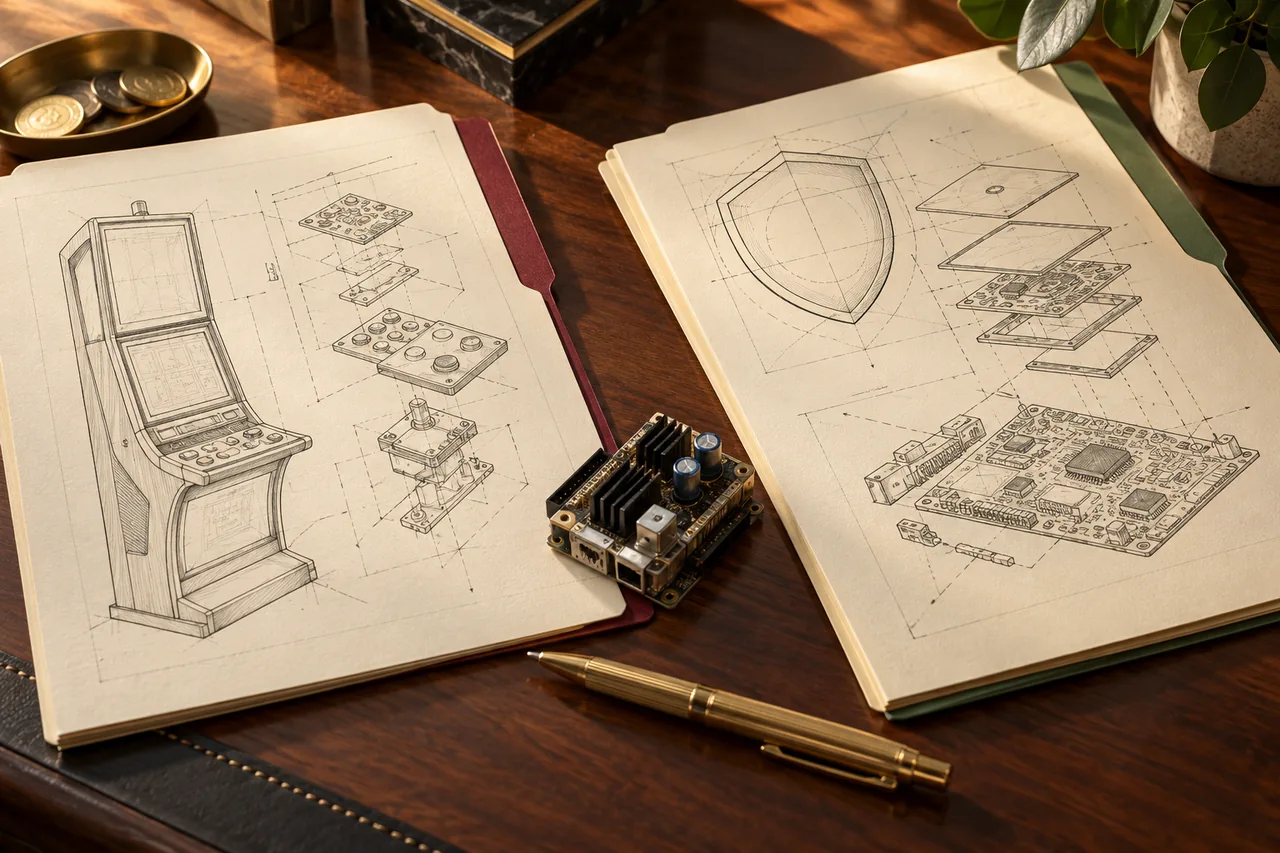
Aristocrat announced an Australian patent licence arrangement with Ainsworth Game Technology on 14 August 2026. The statement describes a royalty-bearing licence to gameplay patents, including the Hold & Spin patent family, alongside a royalty-free licence to responsible-gaming patents. The commercial terms remain confidential. This is a licensing announcement, not a merger or acquisition.
Two parts of the arrangement
The responsible-gaming patent scope described by Aristocrat includes account-based play, digital wallets, configurable limits, self-exclusion, activity tools and messaging, including emerging AI-enabled approaches. The important distinction is the licensing basis: the statement separates that scope from the royalty-bearing gameplay licence. It does not publish a complete commercial contract or identify every future product that might use the licensed inventions.
Access is a step before implementation
A patent licence concerns permission to use protected inventions within its terms. It does not itself establish that a function has been installed, approved or shown to improve customer outcomes. Our analysis is that broader access to a design can be relevant to a supplier ecosystem while leaving substantial work in product development, technical assessment and venue implementation. Those later stages require their own evidence.
Why this belongs in equipment coverage
The supply of cabinets and games is shaped by intellectual property as well as hardware. Licensing can affect what a manufacturer is permitted to develop and how it can incorporate particular mechanics or system functions. A clear article should identify the parties, territory and stated scope, without guessing at confidential fees or assuming that the arrangement settles unrelated disputes.
The Australian significance
The announcement expressly concerns Australia, which gives it a more direct local dimension than an overseas exhibition debut. Even so, the licence is not a blanket regulatory approval for every resulting product. The useful follow-up would be a specific product disclosure or confirmed implementation that explains how the licensed technology is used. Safer-play language should ultimately be evaluated through the controls delivered and their measured effectiveness, not the existence of a licence alone.
Sources & context
Source period: 14 August 2026 · Reviewed for this edition: 15 October 2026
This article combines source-based reporting with clearly identified editorial interpretation. Company statements are not independent product tests. Planned dates and project specifications may change. Regulatory information is general context, not individual legal advice.